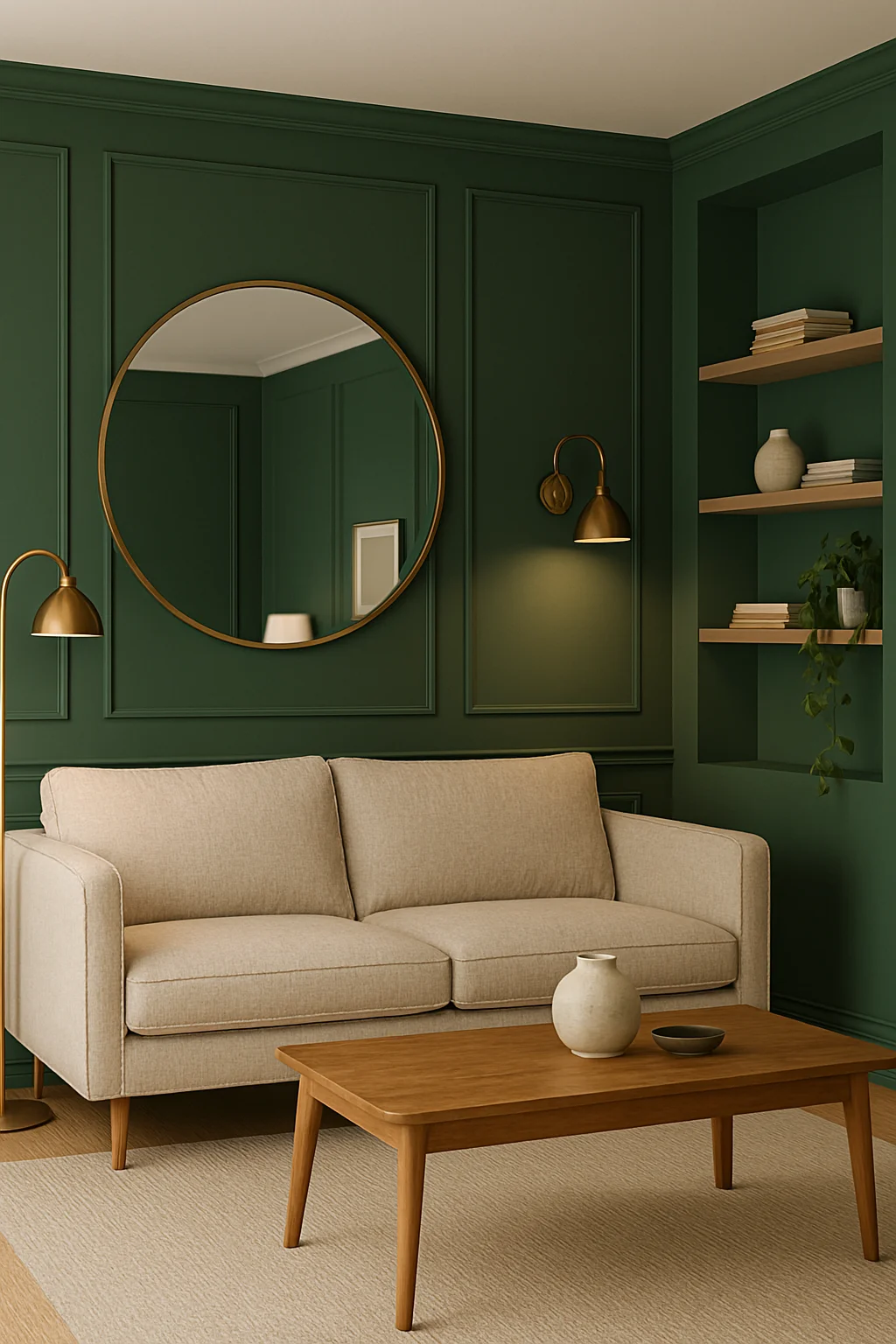
The living room sets the tone for your entire home. These ten wall decor ideas offer practical solutions for UK homes of all sizes. Each concept can be adapted to your specific space and budget.

1. Classic Panel Moulding
Wall panelling adds character to plain walls without major renovation. Install MDF panel moulding in a traditional rectangular pattern across your main living room wall. Use 9mm thick MDF strips in 145mm width, with panels sized proportionally to your wall dimensions.
Paint the entire wall, including the panelling, in one colour for a cohesive look. Dark blues like Hague Blue or Green Smoke from Farrow & Ball work particularly well in UK homes with traditional architecture. For newer builds, lighter tones such as French Grey create subtle texture without overwhelming the space.
Total material cost ranges from £150-300 depending on wall size, significantly less expensive than wallpaper or other wall treatments.

2. Floating Oak Shelving
Oak floating shelves provide practical storage and display space while adding warmth to your walls. Install three 120cm x 20cm solid oak shelves (4cm thick) on your main living room wall or in alcoves beside a chimney breast.
Position shelves at varying heights rather than directly stacked – 40cm vertical spacing works well, with the lowest shelf 100cm from the floor. This arrangement creates visual interest while maintaining usability.
Style shelves with a deliberate mix of books (arranged both vertically and horizontally), 3-4 decorative objects of varying heights, and a small trailing plant. Limit objects to 5-7 items per shelf maximum.

3. Statement Round Mirror
A large round mirror (100cm diameter minimum) adds light and dimension to UK living rooms. Mount centered on your main wall at 160cm from floor to center point.
Choose a thin frame (2-3cm maximum) in either black, brass or natural oak to complement your existing furniture. Position opposite or adjacent to windows rather than directly across to maximize light reflection without glare.
In terraced houses with narrow living rooms, a floor-standing mirror (180cm x 70cm with minimal frame) leaned against the wall creates depth without requiring heavy mounting on potentially fragile plasterwork.

4. Grid Gallery Wall
Create a structured gallery wall using nine identical frames (30cm x 40cm) arranged in a precise grid with 5cm spacing between frames. Choose either all black or all oak frames for coherence.
Mount the grid with its center point at eye level (approximately 160cm from the floor). For content, use black and white photography, botanical prints, or architectural drawings – maintaining a consistent theme throughout all eight frames.
In period homes with picture rails, hang frames from the rail using brass chains, spaced 15cm apart for a traditional gallery effect.

5. Bold Green Feature Wall
Paint one wall in a rich green tone to create a focal point. The wall behind your sofa or your chimney breast works best. Use a deep, saturated green like Little Greene’s Hopper or Farrow & Ball’s Green Smoke.
Keep other walls in neutral tones (not pure white, but soft off-whites like Farrow & Ball’s Wimborne White) to balance the strong colour. This approach defines the space without making it feel smaller.
Green walls pair excellently with natural wood furniture, brass accessories, and textiles in cream, rust, or navy blue.

6. Architectural Wall Lights
Install wall lights 165cm from the floor, positioned to highlight artwork or provide reading light near seating. Choose adjustable brass wall lights with articulating arms that extend 30-40cm from the wall.
For a contemporary space, select two identical wall lights with cylindrical shades and black metal fittings, mounted symmetrically on your main wall with 160cm spacing between them.
In period properties, ceramic wall lights with fabric-covered cables add texture while complementing original features. Position them on either side of a chimney breast or flanking a large mirror or artwork.

7. TV Wall Design
Frame your television with purpose by mounting it on a dark-painted MDF panel that extends 20cm beyond the TV’s edges on all sides. Paint this panel in a deep charcoal or navy blue to reduce the screen’s visual dominance when turned off.
Alternatively, create a balanced arrangement by installing a 120cm floating shelf directly below the TV and styling it with 3-5 low objects (books, small plants, ceramic pieces) that don’t compete with viewing.
For homes with TVs mounted on chimney breasts, paint the entire chimney breast in a darker tone than surrounding walls to help the television blend rather than stand out.

8. Living Plant Corner
Transform an empty corner by installing a tall indoor plant (Fiddle Leaf Fig, Kentia Palm or Snake Plant) in a substantial floor pot (40cm diameter minimum). Position an uplight on the floor behind the plant, directed through the foliage to cast interesting shadows on the walls.
For small spaces, mount three wall-hanging planters in graduating sizes on corner walls, filled with trailing plants like pothos or string of pearls. Position the highest planter 180cm from the floor, middle at 140cm, and lowest at 100cm.
This living element adds texture, improves air quality, and utilizes otherwise dead space.

9. Woven Wall Hanging
Install a large textile wall hanging (100cm × 150cm) centered on your wall. Choose natural materials like wool or cotton in neutral tones with subtle texture rather than bold patterns or colors.
Mount using a simple wooden dowel or copper pipe, positioned approximately 40cm below your ceiling line. The bottom edge should hang no lower than 60cm from the floor.
In UK homes with high ceilings, opt for a longer vertical hanging (60cm × 180cm) to emphasize the room’s height. This textile element adds vital acoustic dampening to rooms with hard surfaces while introducing warmth and texture.

10. Oversized Canvas Art
Mount a single large-scale canvas (120cm × 80cm minimum) as a focal point. Position with the center of the artwork at 160cm from the floor – slightly lower than gallery standard to create a more intimate feeling.
Choose art with a limited color palette that includes 2-3 tones already present in your room. For versatility, abstract landscapes with blues, greens, or neutral tones integrate well with most UK interior styles.
Install a picture light 15cm above the canvas or direct adjustable ceiling spotlights toward the artwork to properly illuminate it, particularly important during dark UK winters.

Practical Implementation Tips
When installing these elements in typical UK homes:
- Use appropriate wall fixings: plasterboard walls require specialized anchors; masonry needs proper wall plugs
- Measure and mark precisely before installation – use a laser level for perfect alignment
- In period properties, avoid drilling into original coving or ornate plasterwork
- For rental properties, consider removable hanging strips rated for appropriate weights
- Always check for pipes and cables with a detector before drilling
Choose items that complement your existing furniture while reflecting your personal style. Focus on quality over quantity – one well-chosen large piece creates more impact than multiple small elements.